Episode Summary
Welcome to the Napa Legal Podcast, where we discuss religious liberty from the perspective of faith-based nonprofits.
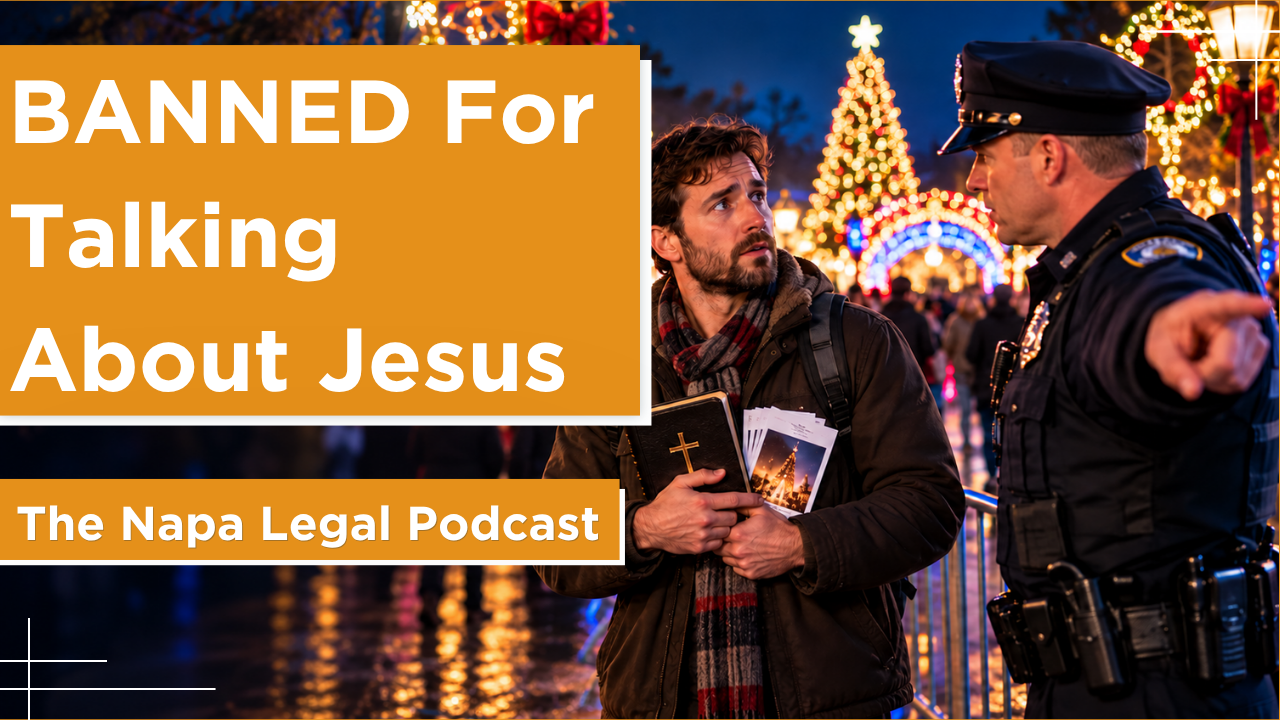
In this week’s episode, Frank DeVito and Kyle Nazareth cover three stories. First, a surprising amicus brief from professors affiliated with the Notre Dame Religious Liberty Clinic. The brief supports the ACLU-led petition asking the Supreme Court to reverse the en banc Fifth Circuit’s decision in Nathan v. Alamo Heights, which upheld Texas’s law requiring the Ten Commandments in every public school classroom. Frank and Kyle explain why they think a poster on a wall involves neither coercion nor religious instruction. Second, a Christian man who was escorted out of the Winter Haven Festival of Lights in Tucson, Arizona, and threatened with arrest for quietly asking attendees if they wanted to talk about Jesus. Police told him this counted as prohibited “sermonizing,” and he is now suing the city with First Liberty Institute. Third, a federal bankruptcy court’s rejection of the Diocese of Oakland’s reorganization plan, and the diocese’s novel argument that pressuring it to sell more churches to pay creditors raises a church autonomy problem.
Chapter markers
0:00 Intro
1:24 The Texas Ten Commandments case, Nathan v. Alamo Heights
1:52 Judge Duncan’s en banc opinion and the hallmarks of a religious establishment
3:28 The case awaits a decision on Supreme Court review
3:38 A Notre Dame Religious Liberty Clinic brief backing the ACLU’s petition
4:19 A real split within the religious freedom movement
5:05 The brief’s claim: Texas forces religious instruction on a captive audience
7:04 Frank: the founders feared denominational dominance, not the Bible
8:29 Early American public schools, the King James Bible, and the Our Father
9:08 No coercion and no instruction: it’s a poster on the wall
10:13 Andrea Picciotti-Bayer: students don’t even have to look at it
10:52 Why Frank now hopes the Supreme Court takes the case
11:07 Kyle: the offended observer problem in new language
12:15 Stone v. Graham, the Lemon test, and psychology as a test for coercion
12:44 A Tucson holiday festival bans religious messaging
13:10 The festival sign and the barricaded “free expression zone”
13:38 Police: asking about Jesus is “sermonizing”
14:12 Hoffman sues, represented by First Liberty Institute and Gibson Dunn
14:42 Is a private festival on a city permit state action?
15:21 Is evangelizing protected speech? Kennedy v. Bremerton and Murdock v. Pennsylvania
16:19 Traditional public forum doctrine: intermediate scrutiny versus strict scrutiny
17:09 Why the festival’s rule is content-based
18:01 Crowd safety, pedestrian flow, and the heckler’s veto under Cohen v. California
19:22 Party bikes allowed, quiet conversations banned: why the rule isn’t narrowly tailored
20:24 Less restrictive alternatives the city could have used
21:08 Kyle: a winter holiday festival that banned Christ, and Paul in the marketplace in Acts 17
22:11 The myth of neutrality: treating the gospel like a sales pitch
23:21 Frank: lumping the most protected speech with the least protected speech
24:09 Private permits on public streets
25:22 An open invitation to lawyers who work on public forum issues
26:23 The Diocese of Oakland’s bankruptcy
27:52 Why the court rejected the reorganization plan
29:27 The diocese’s church autonomy argument
30:44 The court’s response
31:19 Frank: the court answered a free exercise question, not a church autonomy one
32:26 What if a court’s demands would leave Catholics without a parish?
33:38 Wrap-up
Lawyers: applications for the Good Counselor Project, Napa Legal’s fellowship for Christian attorneys, are open until December 1. Learn more at https://www.napalegalinstitute.org/
The Napa Legal Podcast, October 21, 2026
#religiousliberty #freespeech #freedomofreligion
Other Episodes