.png)

Religious Liberty at the U.S. Supreme Court: A 2026-2027 Preview
By Caleb Buzard
As the U.S. Supreme Court begins its 2026-2027work year,the Court faces many serious issues ranging across different topics, from gun rights to 8thAmendment protections toseveral important religion cases. In fact, the scope and diversity of thereligious liberty cases already before the Court this term (with morepotentially on the way) creates the possibility that the upcoming Supreme Courtterm could be a landmark year for religion at the highest court in the land.
In 2022, the Court threwout the decades-old Lemon test in Kennedy v. Bremerton, adopting instead a history and traditiontest for evaluating Establishment Clause claims. In that same year, the Courtheld in Carson v. Makin that government cannot discriminate againstreligious individuals or organizations in the distribution of public funds.
In 2025, the Supreme Courtruled on Mahmoud v. Taylor, which upheld parental rights to determinetheir child’s religious upbringing, and CatholicCharities Bureau v. Wisconsin, which forbadethe government from expressing religious denominational preferences unless thegovernment could meet the strict scrutiny standard.
The 2026-27 term may beshaping up to be another watershed year for religion at the Supreme Court. TheCourt will takes on four important religious liberty cases: Missionaries of SaintJohn the Baptist v. Frederic, St. Mary v. Roy, Grand v. City ofUniversity Heights, and International Partnersfor Ethical Care v. Ferguson. With these cases, the Court has the opportunity to senda strong message about the constitutional rights afforded to parents in thereligious upbringing of their children (St. Mary and Ferguson),the rights of religious organizations against discrimination in access topublic funds (St. Mary), and the right of individuals to worship withoutbeing substantially burdened by onerous government regulations (Missionariesof Saint John and Grand). Because it is early in the term, theCourt may decide to hear additional religious liberty cases this term by granting pendingpetitions of certiorari onseveral important religious freedom cases. In the meantime, the four casesmentioned above are worth highlighting.
Missionaries of Saint Johnthe Baptist v. Frederic
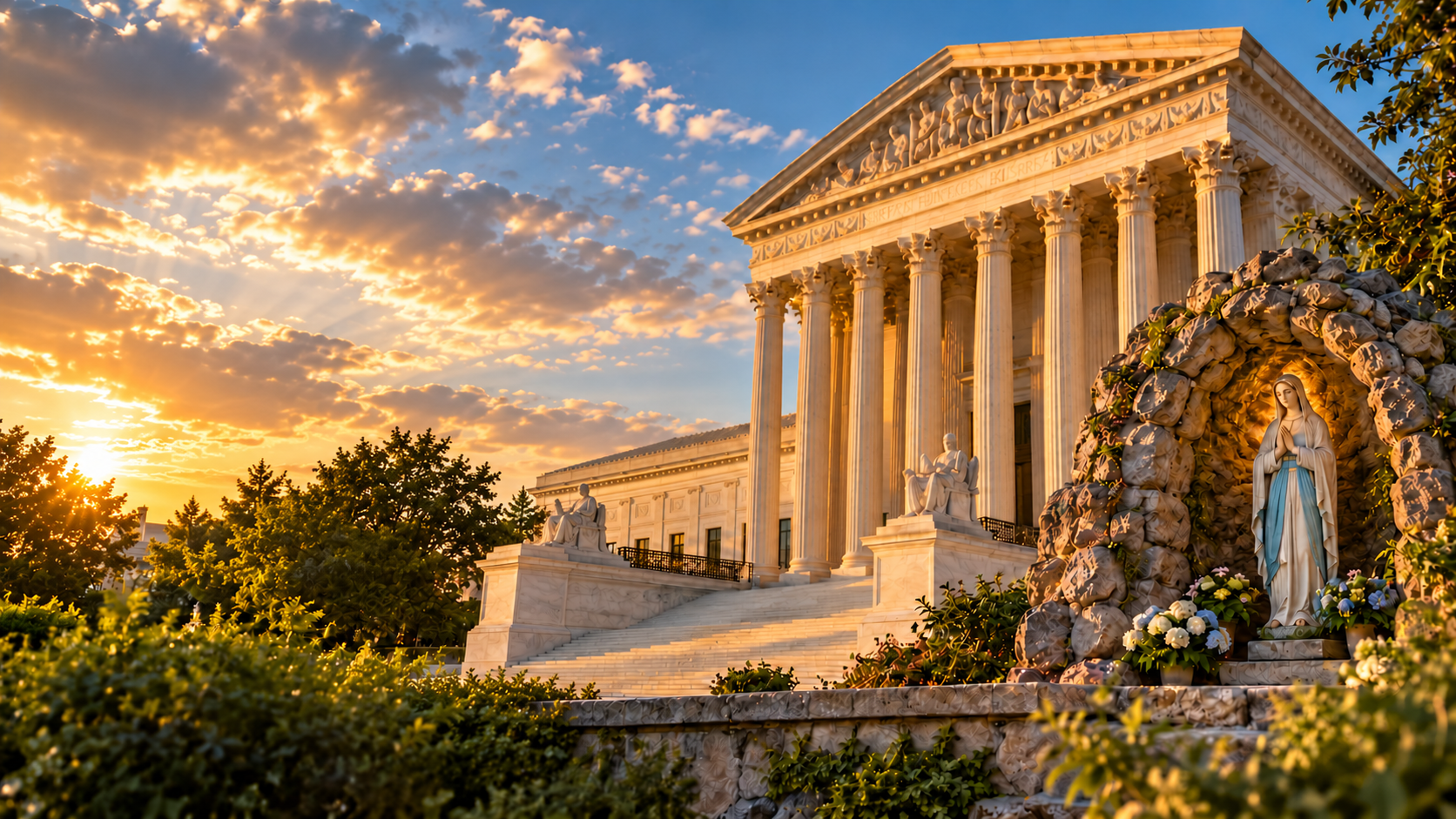
The Missionaries of SaintJohn the Baptist is a Catholic religious organization that operates the OurLady of Lourdes Chapel in the small community of Park Hills, Kentucky. The organization wanted to construct a Mariangrotto on its property, which would be 16 by 39 feet and include only a statueof Mary inside a grotto, a statue of a saint, and a patio and walkway. Despitethe small size of the grotto, and the fact that the organization wished tobuild on its own property, two neighbors objected to the construction of thegrotto, arguing that the local board authorized to enforce zoning restrictionsexceeded its authority in granting the organization a variance to build the grottoin a location where construction is usually prohibited. The neighbors furtherargued that constructing the grotto would lead to a large wave of pilgrims congestingthe neighborhood’s streets, with concomitant traffic, parking, and safetyconcerns.
The U.S. Supreme Courtgranted certiorari from the Missionaries’ appeal of the Kentucky SupremeCourt’s order in favor of the neighbors. The Court will review one question:whether a land-use regulation that prohibits a religious institution frombuilding a religious structure on its own property constitutes a “substantialburden” on religious exercise under the Substantial Burden Provision of theReligious Land Use and Institutionalized Persons Act (RLUIPA). The KentuckySupreme Court adopted the narrow Livingston standard for evaluatingRLUIPA substantial burden claims. The Livingston standard is afour-factor test, onepart of which is whether a“plaintiff has imposed a substantial burden upon itself . . . [f]or examplewhen an institutional plaintiff has obtained an interest in land without areasonable expectation of being able to use that land for religious purposes.”The Kentucky Supreme Court relied on this factor in holding that the chapel’sburden was “self-imposed” because it knew of the Park Hills ordinance andacknowledged the problem it faced in constructing the grotto, but proceededwith the attempted construction nonetheless.
While oral arguments havenot yet been scheduled, the Missionaries of St. John the Baptist, along withmany amici (including NapaLegal) willask the Court to clarify the proper interpretation of “substantial burden”under RLUIPA, and rule on whether the multi-factor Livingston standardis really the test courts should apply to RLUIPA claims moving forward.
St. Mary Catholic Parish v.Roy
In St. Mary CatholicParish v. Roy, the Court will hear a case bearing on parents’ rights tohave a say in their child’s religious upbringing, as well as on the state’sability to discriminate against religious organizations in the allocation ofpublic funds and resources.
Colorado parents Dan andLisa Sheley are raising their seven children in the Catholic faith and havebuilt their lives around the St. Mary Catholic Parish school and faith community.The Sheleys have chosen St. Mary as the locus of spiritual and academiceducation and growth for their children, as a place where they can interactwith peers who share their values, faith, and priorities. In 2023, Coloradolaunched a preschool funding program to provide eligible families approximately$6,300 to cover the cost of preschool. However, the program excluded religiouspreschools whose faith-based admissions policies allegedly conflict withColorado’s public accommodations laws. This exclusion affects 1,500 childrenacross 30 Catholic preschools in the Archdiocese of Denver alone.
Families like the Sheleysfaced a choice: send their children to a Catholic preschool and pay thousandsof dollars out of pocket for the Catholic education and community they value orpull their children from the Catholic preschool and lose the benefits that comewith it. Already, Colorado’s Catholic preschools have seen significant declinesin enrollment and some parish preschools have even closed due to decreasedfunding and enrollment.
The Court must settlewhether Colorado’s exclusion of Catholic preschools like St. Mary that makefaith-based admissions decisions violates the First Amendment and isinconsistent with cases such as Carson v. Makin and Employment Division v.Smith. The case will have significant consequencesboth for education and religious exercise generally. The Court here has the opportunity to expand on Carson byholding that the State cannot discriminate against religious organizations inthe allocation of public resources just because those religious organizationsmake faith-based hiring or admissions decisions.
Grand v. City of UniversityHeights
Daniel Grand is an Orthodox Jew; Jewish lawrequires Grand to pray three times per day with a minyan (a quorum of 10 Jewishmen). However, because most of the city’s synagogues are on the outskirts oftown, travel for Grand and other worshippers is difficult, especially on theSabbath when orthodox Jews are prohibited from operating a motor vehicle.
Grand decided to start a prayer group in hisown home to ease the burden on his religious community. Grand’s neighbors,however, complained to the city about the gathering. The city then sent Grand acease-and-desist letter ordering him to shut down the prayer group. The mayorreportedly called Grand and told him that “under no circumstances” could theprayer group proceed inside his own home. The city called Grand’s home an “illegal synagogue.”
The city forced Grand to defend himself in araucous public hearing, in which veiled anti-Semitic sentiments were allegedlyexpressed by members of the community. At the end of the hearing, theburdensome compliance rules imposed on Grand, coupled with the fact that if hewere successful in having his home recognized as a place of worship he would beunable to reside there, led him to withdraw his application to host the prayergroup. Despite Grand’s voluntary withdrawal, the mayor allegedly told membersof the public to report any evidence of a prayer gathering at Grand’s house andeven instructed the police to conduct drive-bys of Grand’s residence forevidence of prayer gatherings.
Grand’s primary arguments are that the city’sactions are unconstitutional under the First Amendment and the Religious Land Use andInstitutionalized Person’s Act(RLUIPA: a federal law intended to protect religious exercise from burdensomepublic land-use regulations). Grand urges the Supreme Court to reject theapplication of a case called Williamson County v. Hamilton Bank, which ordered that any claimants seekingrelief from local land-use ordinances or actions must go through theirmunicipal zoning process completely before filing a complaint in court. Grandargues that Williamson County does not apply to his case, because WilliamsonCounty was decided in the context of a government takings argument (theclaim that the government is taking land from a private citizen without justcompensation in violation of the Fifth Amendment). Grand urges the Court tohold that Williamson County is not applicable here because his case hasnothing to do with a takings argument and worshippers should be able to haveeasy access to courts when the government restricts their free exercise.
The Court will answer the following question:whether the First Amendment’s chilling-effect doctrine allows a plaintiff tobring a lawsuit based on government threats that deter religious exercise andassembly, even without a final land-use decision from the government.
International Partners for Ethical Care v.Ferguson
Historically, Washington State requiredlicensed youth shelters to notify parents within 72 hours whenever a runawayminor arrived at their facility. However, two 2023 state laws changed thisframework by adding an exception to the parental notification requirement: thatparents need not be notified when a runaway child is seeking services that include“gender-affirming treatment.” Under the law, youth shelters must notify the statebefore the parents if a runaway child is seeking procedures that purport tochange the child’s gender. The petitioners to the Court are five sets ofparents whose children experience gender dysphoria; the parents refuse toaffirm a gender identity contrary to their child’s biological sex.
This case has important religiousliberty implications.Supporters of the parents argue that parents have the right to direct thereligious upbringing of their children. This extends to parental teachingsabout family life and human sexuality, which lie at the heart of mostreligions. The Washington State law impairs this right in several differentways. First, by circumventing parental notice, the state is potentiallyabridging parental religious liberty by allowing their children and the Stateto make decisions for the child in direct contradiction to the parent’sreligious interest. Second, the law gives cover to supposed “safe spaces,” suchas public schools, in which children experiencing gender dysphoria can besocially transitioned by teachers and peers without the parent ever knowing,again in violation of their religious freedom and parental rights. The Court’sruling on this law could have major consequences for the rights of parents to directtheir children’s religious upbringing.
Pending Cases to Watch
The Supreme Court may not be done takingimportant religious liberty cases for the upcoming term. There are at least twosubstantive religious liberty cases the Court could still hear in the upcomingyear.
Hall v. Fleming: Liberty University student Bethany Hall ischallenging a Virginia law that excludes students pursuing certain religiousdegrees from obtaining critical state tuition support. The question in thiscase is whether the State’s denial of public tuition support to Hall, solely onthe basis of her religious course of study, violates her free exerciserights.
Olympus Spa v.Armstrong: aWashington State health clinic, Olympus Spa, is a traditional Korean spapracticing certain traditional Korean customs, including having an opencommunal space in which patrons sit together fully nude. The spa is also ownedby Christians with devout and sincerely held religious beliefs; in accord withthese beliefs, the owners do not believe that men and women should be unclothedtogether outside marriage. As such, the spa admits only female patrons andhires only female employees. In 2020, a biological male identifying as a womanchallenged the female-only policy, arguing that it violated his rights underWashington’s public accommodation laws. If the Court grants certiorari, thiswould test the extent to which business owners engaging in commercial activitycan rely on First Amendment and free exercise arguments when their beliefs arein conflict with state public accommodations laws.
Conclusion: A Busy Term at the Court forReligious Freedom
Thisis already shaping up to be a significant and potentially historic term at theSupreme Court for religious freedom. The Court has the chance to expandimportant precedents and strengthen religious liberty, especially as it relatesto parental rights. Be sure to keep an eye out: this term may change thereligious liberty landscape for years to come!
.jpg)